 AI concept illustration
Stop-go traffic, without the clutch work
Switch to manual with automated clutch, or to automatic, and PGT handles every engagement while you keep choosing how to drive.
In the modes your vehicle offers.
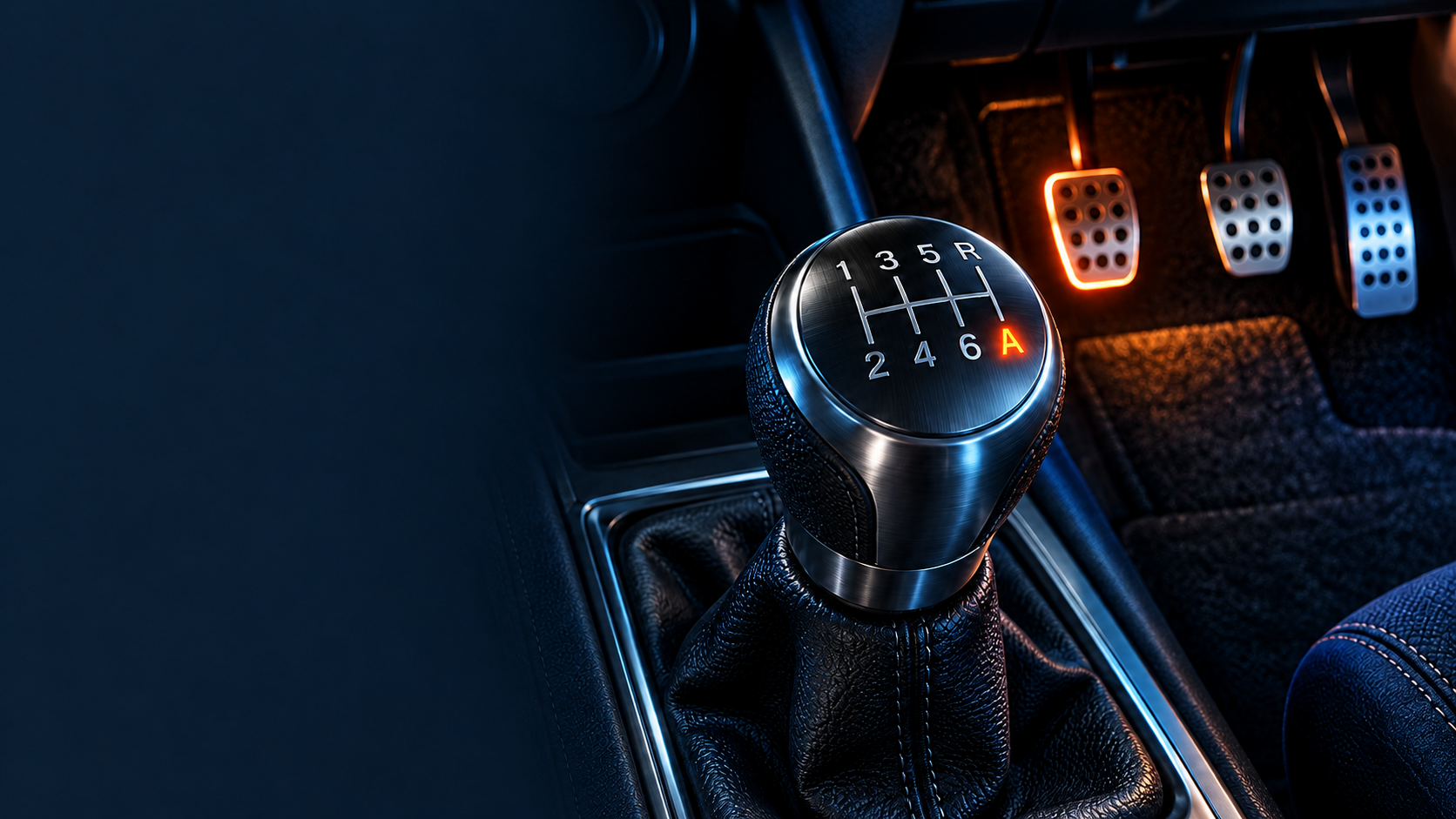
PGT keeps a real clutch and a real gearbox, and changes who commands them: you, the car, or the two of you together.
Patented transmission concept
AI concept illustration
Polymorphic means taking many forms. PGT gives one transmission several ways of being driven, without replacing the hardware drivers and workshops already understand.
Pick a mode and watch who sends each request. The physical clutch and gearbox stay in place every time; only the source of the command changes.
Press the clutch pedal and choose your gears. A sensor reads how far you press, and the control unit turns that into electronically actuated clutch movement.
Illustrative control allocation, not a vehicle control. Available modes and switching rules vary by vehicle.
From pedal-led driving to a fully automatic commute, PGT is designed to let the same car match the road, the traffic and the mood you are in.
AI concept illustrationSwitch to manual with automated clutch, or to automatic, and PGT handles every engagement while you keep choosing how to drive.
In the modes your vehicle offers.
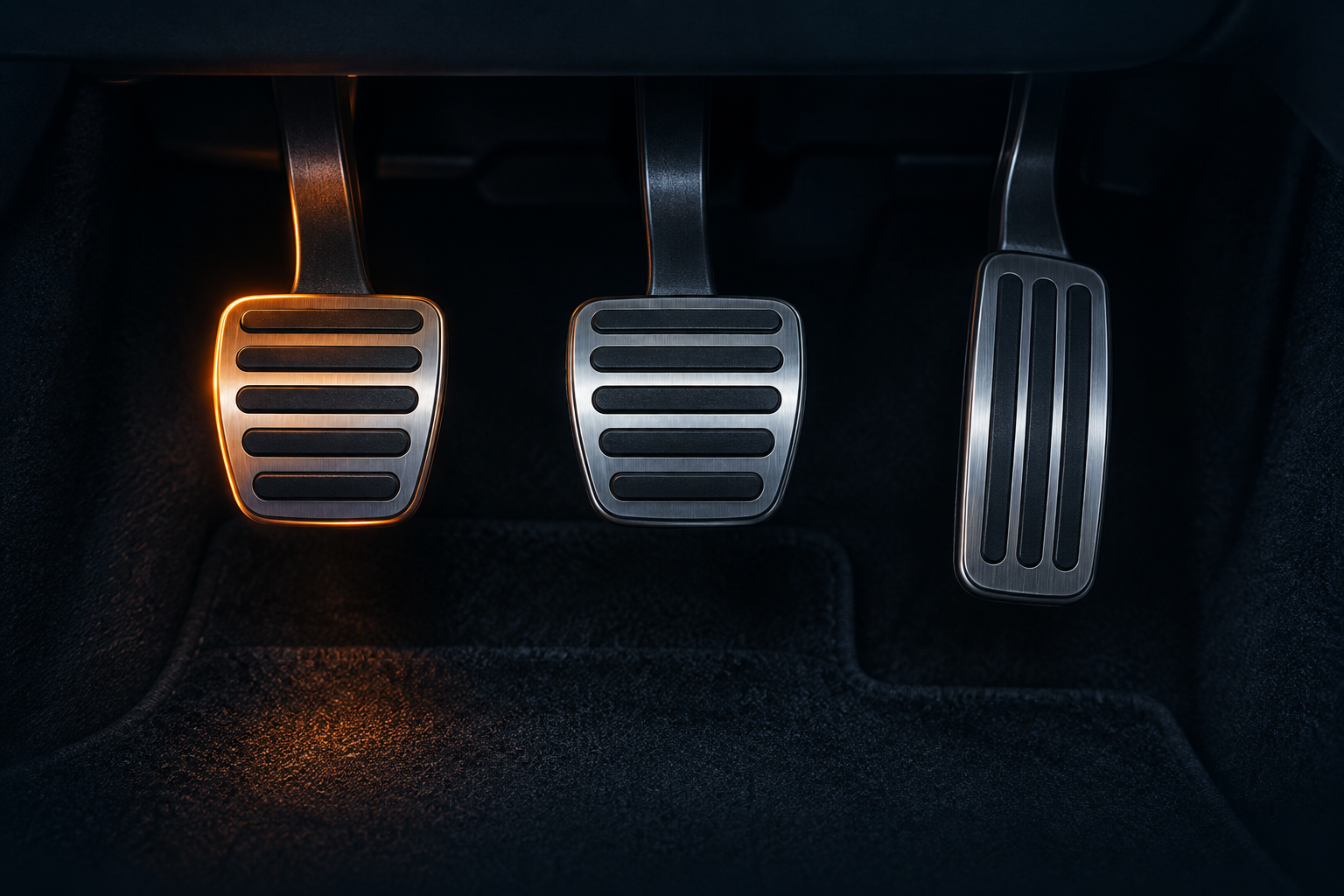 AI concept illustration
In manual, the clutch pedal becomes a sensed request. Its feel is designed separately from the clutch release load, so it can stay light and consistent.
Pedal feel is tuned for each vehicle.
 AI concept illustration
Creep in first and reverse, hill-start support and an anti-stall response are part of the concept, coordinated with engine and brake data.
Subject to vehicle configuration and validation.
PGT lets a vehicle programme explore several driving experiences around shared transmission hardware and controls, and decide which ones each variant offers.
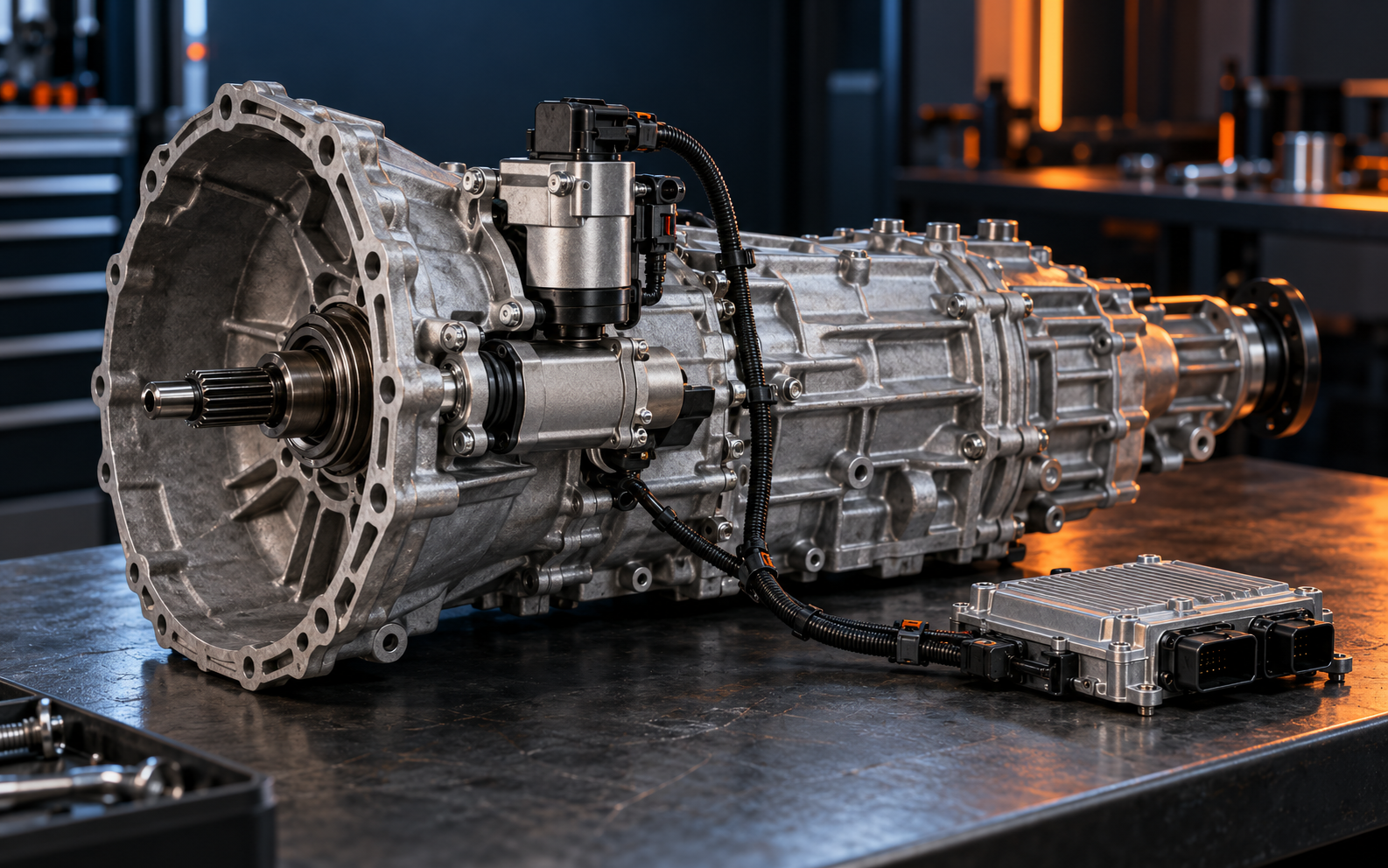
Configure a dedicated manual, a dedicated automatic or a multi-mode variant from the same transmission architecture.
Explore reuse of the clutch, gearbox, actuators, controls and service knowledge across variants of a compatible programme.
Driver inputs are sensed, so pedal feel and selector layout can be designed independently of gearbox packaging.
The concept learns changes in the engagement point and raises a service alert at a configured threshold.
Reuse is a programme-specific opportunity. Any saving depends on integration, added electronics, validation, production and lifecycle costs; no measured cost reduction is claimed.
Every mode follows the same three steps. What changes is whether the request comes from your foot and hand, or from the control unit itself.
Sensors read the clutch pedal position and the gear lever request. In the concept, the lever is not mechanically linked to the gearbox.
The transmission control unit combines that request with engine and vehicle data such as speed, engine RPM, throttle position and wheel speed.
A clutch actuator moves the clutch and a gear actuator selects the gear. The physical clutch and gearbox do the work, in every mode.
Each depends on how the vehicle is configured and validated.
Patented transmission concept
Concept designed by Diwakar M Annamalai and Sathiya Jothi. Patent details are shared in technical and licensing discussions.
Open for evaluation
PGT has not yet been built into a production vehicle. Benefits describe design intent, and each vehicle needs its own engineering, calibration, safety analysis and validation.
Looking for vehicle manufacturers, transmission suppliers and engineering partners who want to evaluate PGT for a real programme.
Discuss PGTSomething else on your mind? Ask directly.
No. A physical clutch remains. In every mode an actuator operates it under electronic control.
No. The pedal supplies a sensed request. The control unit interprets it and commands the clutch actuator; the pedal does not move the clutch directly.
Not necessarily. A manufacturer may offer one mode, a combination or all three, with switching rules defined for that vehicle.
In a three-mode car it stays fitted. Its input is switched off in manual with automated clutch and in automatic.
PGT monitors the clutch pedal sensors for faults. If it detects one, it alerts the driver and switches to automatic mode by default, so the clutch is still operated for you. This depends on automatic mode and the rest of the control path being healthy. The alert clears once the fault is resolved or serviced.
No. Automatic refers to the transmission only. The driver still steers, accelerates, brakes and drives the vehicle. PGT is, however, designed to integrate with autonomous driving systems: its clutch and gears are already electronically actuated, and the concept names autonomous and driver-assistance (ADAS) vehicles as applications of its automatic mode. Each integration is engineered for the target vehicle.
Those automatic transmissions are normally driven with two pedals and no clutch pedal. An AMT uses actuators to work a manual-type gearbox and clutch, a DCT shifts between two clutches, and a torque-converter automatic or CVT manages launch and ratios itself. PGT keeps a real clutch and gearbox and works them with a clutch actuator and a gear actuator under a transmission control unit. In a three-mode configuration, the same car can be driven as a manual transmission, a manual with automated clutch or an automatic transmission.
PGT is aimed at powertrains that drive through a clutch and a stepped gearbox, such as engine-driven cars. In a hybrid, the drivetrain architecture and safety rules are assessed for each vehicle. A typical single-speed electric car has no clutch or ordinary gear changes, so most PGT benefits would not apply.
Each vehicle needs an engineering assessment. Actuator installation, control interfaces, calibration and validation are specific to the target vehicle.
Not yet. No comparative measurements exist for those outcomes. They are questions for a defined engineering and business evaluation.
Yes. PGT is a patented transmission concept, designed by Diwakar M Annamalai and Sathiya Jothi. Patent details are shared in technical and licensing discussions.

Tell us about the vehicle, the driving situation or the engineering question you want to explore. Messages reach the concept designer directly.